Whiffle, in collaboration with RWE — a global leader in wind energy production — has completed an extensive validation of its meso-scale model and micro-scale Large Eddy Simulation (LES), demonstrating significant reductions in wind speed bias and uncertainty. This landmark analysis benchmarks the Whiffle meso-scale model and LES against a dataset spanning 170 sites and over 300 measurement locations. With an unprecedented 170 years’ worth of LES simulation data, the study evaluates model performance across both offshore and onshore locations, incorporating multiple measurement locations per site for comprehensive analysis.
A rigorous validation of Whiffle’s meso-scale model and LES
The validation study followed a standardized modelling approach using Whiffle Wind’s default configuration, ensuring consistency with operational performance. The 100m resolution LES is nested in a 2 km resolution meso-scale model, hereby capturing both large-scale atmospheric patterns and fine-scale wind variations. Data representing virtual meteorological masts (VMMs) was recorded in both the meso-scale model as well as in the LES, enabling a one-to-one comparison of meso-scale and LES data with observations.

Site and measurement location (meta)data was meticulously compiled and validated by RWE. The analysis was performed on 10-minute time series data and restricted to locations featuring at least 90 days of overlapping data and measurement heights with over 50% availability. This methodology provided a robust basis for evaluating model performance.
Key findings: Wind speed bias and uncertainty reduction
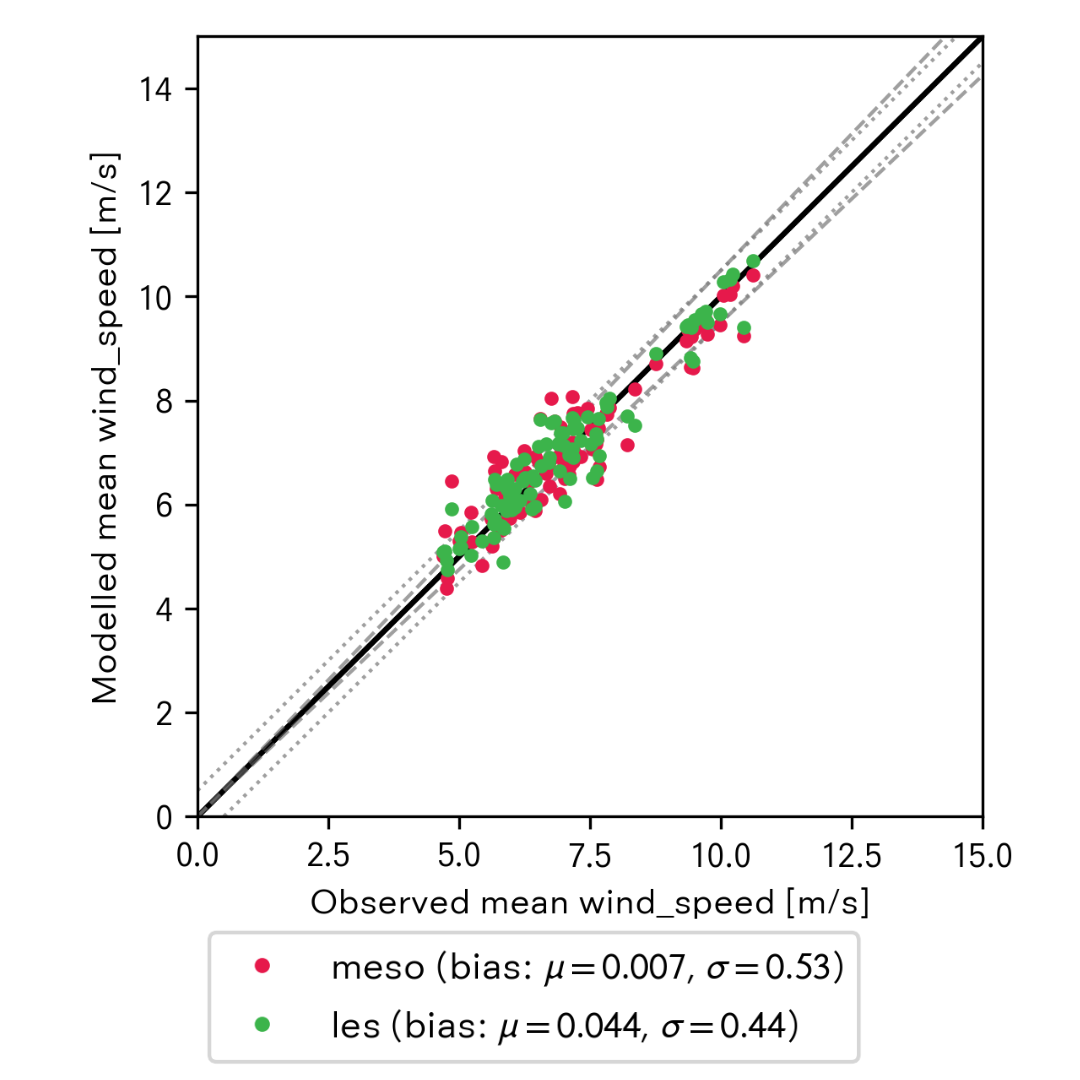

- The Whiffle Meso & LES model show very good performance, with standard deviations of 0.4 m/s (LES) and 0.5 m/s (Meso).
- Compared to other state-of-the-art data sets like NEWA-WRF, this a reduction of the uncertainty by a significant amount – by nearly a factor of two.
- As expected, the LES shows better performance than the meso-scale data, but surprisingly the meso-scale data only has a slightly higher uncertainty.
“This study represents an unprecedented effort in benchmarking wind model data against real-world measurements at this scale. As wind projects grow in complexity and financial stakes increase, accuracy in resource assessment has never been more critical. This comprehensive dataset has allowed us to validate the significant advantages of using higher-resolution models, such as Whiffle’s, particularly for onshore sites, in reducing wind speed bias and improving the precision of wind resource assessments.”
— Sam Williams, Senior Scientist, RWE
Next steps
Whiffle and RWE plan to continue their collaboration with a follow-up validation focusing on cross-prediction capabilities, scheduled for next year.
“Our collaboration with RWE is a valuable opportunity to benchmark our meso-scale model and Large Eddy Simulation (LES) against one of the most extensive real-world wind measurement datasets available. The scale and depth of this validation brings an exceptional level of scientific rigour to our model development process, enabling us to systematically find current model limitations and inaccuracies. By continuously aligning our model development roadmap with these findings, we are making significant strides towards establishing a new industry standard for accuracy and reliability in wind modelling for wind resource assessments.”
— Pim van Dorp, R&D Director at Whiffle
Detailed findings from this validation study will be presented at the upcoming WindEurope conference by RWE. More information on their presentation can be found here.
About Whiffle
Whiffle B.V. was founded in 2015, starting as a spin out of the Dutch Delft University of Technology. With its roots in science, the company continues to use cutting edge R&D to further develop Large Eddy Simulation (LES) models and its unique implementation on high performance computing systems. This resulted in the world’s first Large Eddy Simulation (LES) based operational weather model that produces highly accurate and ultra high-resolution weather forecasts. Application areas of Whiffle’s model include short-term wind and solar power forecasting, wind resource assessments and wind energy yield modelling.
About RWE
RWE is a leading global renewable energy company headquartered in Germany. With a strong commitment to sustainability, RWE is driving the energy transition through extensive investments in onshore and offshore wind, solar power, battery storage, and hydrogen solutions. Leveraging decades of expertise and innovative technologies, RWE develops, builds, and operates renewable energy projects worldwide, significantly contributing to the growth of clean, reliable, and affordable energy.