
Article written by Peter Baas (Scientist at Whiffle)
How much energy will the Dutch offshore wind programme actually produce? That question reached parliament earlier this year, following a discussion that was sparked by a publication by Simão Ferreira et al. (2026).
The authors of this publication stated that the Dutch policy target overestimates expected production of future offshore wind ambitions by 50%. This message got picked by several national newspapers*, led to questions in parliament and subsequent public hearings. In a first session, the authors of the original publication explained their findings. In a second session, experts of TNO and Whiffle, together with officials from the Ministry of Economic Affairs and Climate compared the results of Simão Ferreira et al. (2026) to those of other recent studies and put the discussion on offshore wind energy production into a wider perspective.
Soon after the publication of Simão Ferreira et al. (2026), Whiffle got involved in the discussion mainly because of the study we performed last year on the energy production of the Dutch 21 GW offshore wind energy Roadmap. This study was issued by the Dutch government to obtain a better understanding of how wake effects may impact future production numbers.
In this piece we reflect on the ongoing discussion. A first topic of debate is the meaning and relevance of the frequently used term ‘capacity factor’, which is defined as the ratio between the production of a wind farm (or collection of wind farms, e.g., from a particular country) divided by the installed capacity. Usually, modelling studies on energy production report capacity factors based on idealized conditions where turbines are operating 100% of the time. In reality, capacity factors are lower due to, among other reasons, turbine malfunctioning, curtailment following bats and bird regulations or cable losses. These factors combined may easily reduce the idealized modeled production by 10 to 15%.
Rather than using a single fixed value for the capacity factor, Dutch policy documents apply a range of capacity factors of between 42 and 58%. The latter value is an optimistic estimate, but the former is in close agreement with the outcome of the Whiffle study to the 21 GW Roadmap (including 10% operational losses). Comparable numbers were reported by a study of the Fraunhofer Institute for Wind Energy Systems issued by the German government. Capacity factors of individual wind farms may vary considerably depending on the wind farm size, installed capacity density, and the presence of and distance to any neighbouring wind farms.
Over the years, it has become clear that the large-scale rollout of offshore wind energy comes with larger wake losses than originally anticipated. Governments actively follow scientific developments and include new insights in policy developments as illustrated in the Dutch government’s response letter on this topic, where the results of the Whiffle study were used as a benchmark.
Applying a simple analytical model, Simão Ferreira et al. (2026) estimate the capacity factor of the future Dutch offshore wind ambitions to be 34.6%. This is considerably lower than the values reported by the Whiffle study to the 21 GW Roadmap and the study by Fraunhofer IWES. The main reason for this is that Simão Ferreira et al. 2026 use a single 10 GW wind farm with an installed capacity density of 10 MW / km² as a proxy for the future Dutch offshore wind energy ambitions. In the public hearing in parliament we argued that this hypothetical case is not representative for the 21 GW Roadmap, nor for a further expansion towards 40 GW in the following decades. This was also argued in a scientific memo by Watson and Von Terzi (2026) that was added as an Appendix to the above-mentioned government response letter.
We appreciate the conceptual character of the model applied by Simão Ferreira et al. (2026), and how it combines basic atmospheric boundary layer physics with the wind resource. Earlier application of this model showed good agreement with actual production data for different wind farms. However, this model was originally developed for infinite wind farms. To obtain results for wind farms of finite size, a correction has been included. This is done by identifying the number of turbines that experience undisturbed conditions and using a free-stream capacity factor for those. But as demonstrated in detail by Van der Laan and Watson (2026) the model outcome is strongly dependent to the way this finite wind farm correction is done. They also argue that, irrespective of the applied finite wind farm correction, it is not trivial how to account for upstream wind farms at varying distance.
This is where the strength of higher-fidelity models comes in. Models like Whiffle’s Large-Eddy Simulation based weather model solve the full complexity of the atmospheric flow including processes like turbulent mixing, atmospheric stability, and low-level jets. Mesoscale effect like sea-breezes and gravity-waves are explicitly resolved by the model as are topographical features like land-sea transitions and mountains. Any desired wind farm scenario can be included in the model simulation. and both internal wake effects and farm-to-farm interactions will be naturally represented in the model. By adding or leaving wind farms at specific locations differences between wind energy scenarios can be studied in detail.
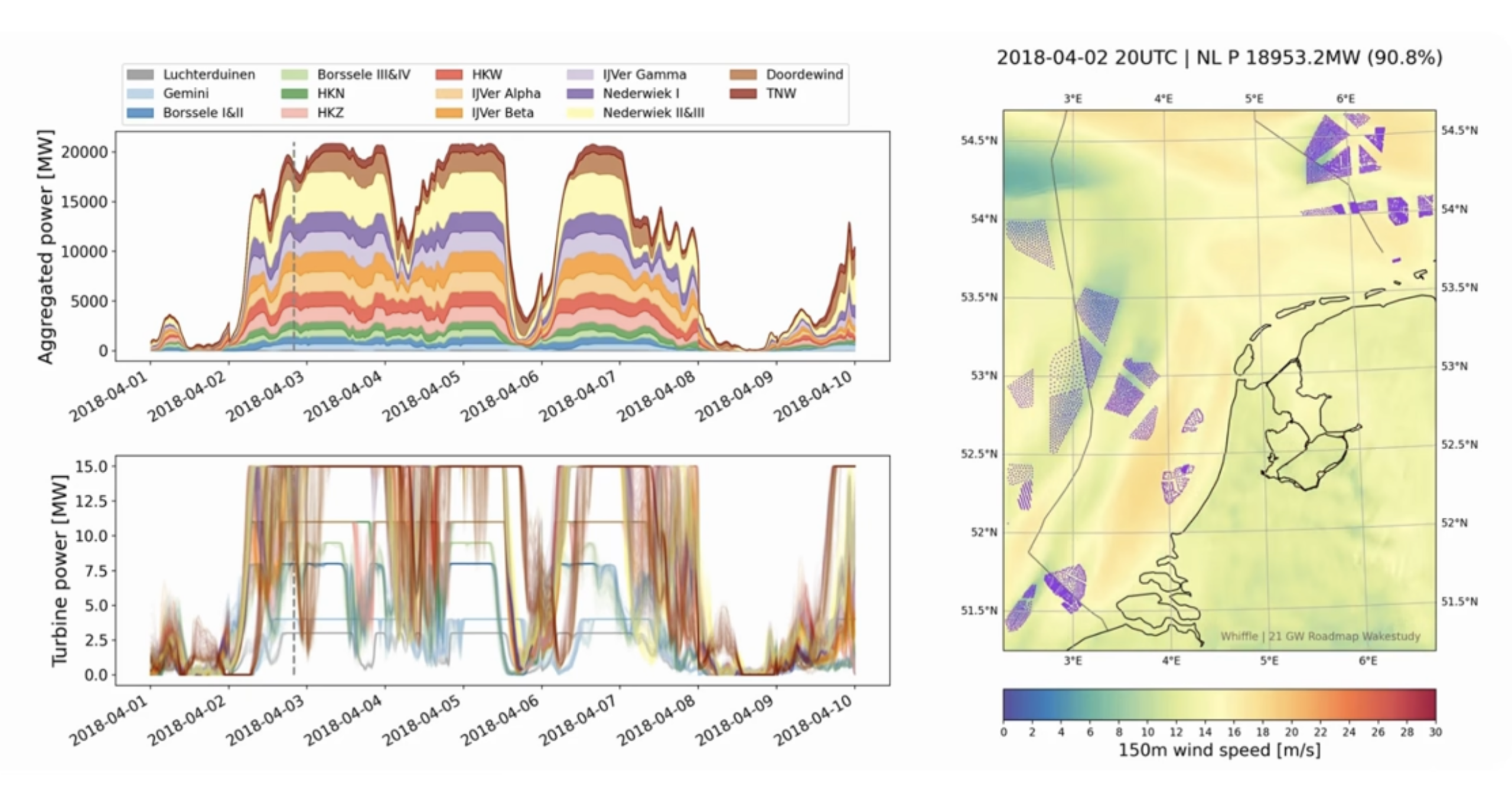
This is illustrated in the animation which shows the evolution of the wind field in time. The animation is taken from the Whiffle 21 GW Roadmap study and shows the chaotic nature of weather systems passing by. Downstream of the wind farms, clear wake effects are visible that may propagate for tens of kilometers. For each wind turbine and wind farm the energy production is constantly calculated and can be followed in time, which is shown in the animation as well. Higher-fidelity models like these provide the most reliable answer to questions on offshore wind energy production and wake effects, especially in a setting with many wind farms that are interacting with each other.
To summarize, a research paper employing simple analytical model instigated a discussion on the energy production of planned offshore wind farms stating that Dutch policy target overestimate expected production for future offshore wind ambitions by 50%. We argue that a comparison with policy targets is not trivial as in practice a range of capacity factors is applied. Also, the assumed single 10 GW wind farm is not considered representative for future Dutch offshore wind farm scenarios. Finally, for accurate assessment of energy production and wake losses higher-fidelity weather models are essential, especially in a case with many interacting wind farms like the North Sea.
*This discussion was covered by several media outlets. A selection:
- Trouw: Veel minder windenergie in 2040 door rekenfout van ministerie
- Telegraaf: Klap voor klimaatbeleid: ’Opbrengst windparken op zee 50 procent lager dan waarop overheid rekent’
- RTL: Veel minder windenergie dan gedacht: door het weer, maar ook door fout ministerie
- Change.inc: Zorgen over stroomopbrengst windparken op zee overdreven